Beautiful Offices, Broken Collaboration: What Your Renovation Budget Is Missing

The Renovation That Changed Everything — Except the Behavior
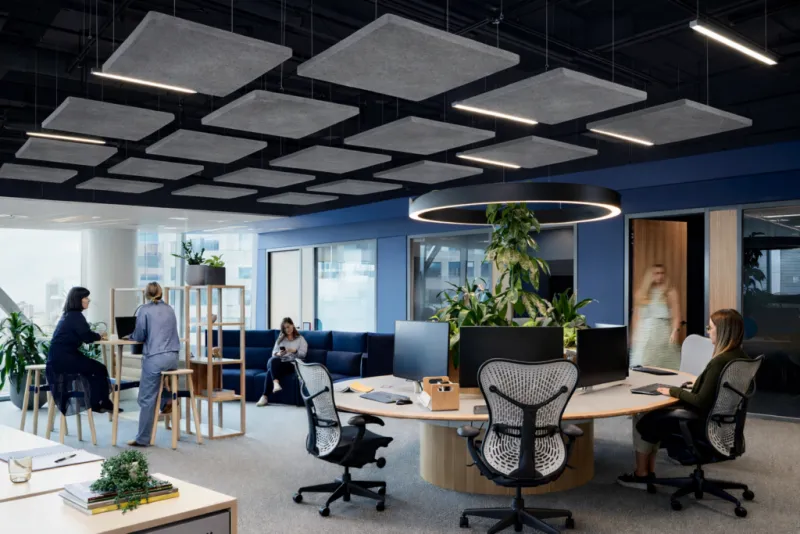
The announcement came with considerable fanfare. A Fortune 500 manufacturer unveiled its newly reimagined headquarters: 40,000 square feet of open collaboration zones, standing-height communal tables, whiteboards on every wall, and a barista-staffed coffee bar positioned deliberately at the center of each floor. Leadership expected the investment — north of $2 million — to dissolve the departmental boundaries that had quietly strangled cross-functional innovation for years.
Twelve months later, an internal survey told a different story. Employees rated interdepartmental collaboration no higher than they had before the renovation. Product and engineering teams still scheduled formal meetings to communicate what could have been a hallway conversation. The coffee bar, it turned out, attracted the same clusters of colleagues who already knew each other well.
This organization's experience is not an anomaly. It is, in fact, a pattern that workplace strategists encounter with striking regularity across industries — from financial services firms in New York to technology companies in Austin. The pattern has a name: the collaboration paradox.
Why Physical Space Is a Necessary but Insufficient Condition
There is a persistent executive assumption that proximity breeds partnership. The logic is intuitive: remove the walls, reduce the distance between desks, and people will naturally begin talking, sharing ideas, and co-creating solutions. Workplace design firms have built entire service lines around this premise, and the commercial real estate industry has largely embraced it as orthodoxy.
The behavioral science, however, is considerably more nuanced. Research published by organizational scholars at MIT and Harvard over the past decade consistently shows that physical proximity increases the frequency of interaction, but it does not determine the quality or purpose of those interactions. Two employees who pass each other daily at a shared coffee station may exchange pleasantries indefinitely without ever engaging on a substantive professional level — particularly if their organizational incentives, reporting structures, and performance metrics pull them in different directions.
In other words, space can create opportunity. It cannot create motivation.
The Cultural Infrastructure Gap
When enterprise leaders diagnose a collaboration problem, they tend to reach for the most visible lever available: the physical environment. This is understandable. Renovating a floor is a concrete, measurable action with a defined budget and a completion date. Shifting organizational culture is slower, messier, and far harder to report on in a quarterly earnings call.
But the gap between where most companies invest and where the actual barriers to collaboration reside is significant. Consider the conditions that most commonly prevent genuine cross-team innovation in US enterprises:
-
Misaligned incentive structures. When individual performance reviews and bonus calculations reward siloed output rather than collaborative contribution, employees rationally prioritize their own team's metrics. No amount of open floor plan will override a compensation system that penalizes time spent helping another department.
-
Unclear psychological safety. Employees who fear that proposing unconventional ideas across team lines will expose them to criticism or political risk will not use a whiteboard wall to brainstorm, regardless of how prominently it is positioned.
-
Absence of structured cross-functional rituals. Spontaneous collaboration is largely a myth at the enterprise level. The organizations that consistently report high cross-team innovation tend to have deliberately engineered recurring moments — working groups, shared project sprints, joint retrospectives — that make interaction habitual rather than accidental.
-
Leadership behavior that contradicts the design intent. When senior executives continue to operate in enclosed corner offices or conduct all meaningful decision-making in closed-door meetings, the signal to the broader organization is clear: the open space is for everyone else.
What Evidence-Based Workspace Strategy Actually Looks Like
None of this is an argument against thoughtful office design. The physical environment remains a meaningful variable in shaping employee behavior — it simply cannot do the work alone. The organizations that extract genuine innovation value from their workspace investments are those that treat design as one component of a broader, integrated strategy.
Several principles distinguish their approach:
Anchor design decisions in behavioral data, not aesthetic preference. Before committing capital to a redesign, high-performing organizations conduct rigorous occupancy analysis and behavioral observation. They map how employees actually move through a space, which teams interact organically, and where friction points exist. This data frequently reveals that the collaboration problem is not a shortage of open space but rather a shortage of semi-private, acoustically appropriate environments where employees feel comfortable having substantive conversations.
Align space typologies with specific work modes. Effective collaboration is not a single activity. It encompasses everything from a two-person problem-solving session to a twenty-person cross-divisional workshop. Designing exclusively for one mode — typically the large, visible, open-plan variety — underserves the full spectrum of collaborative work. Enterprises that invest in a deliberate mix of space typologies, including small enclosed rooms, informal lounge settings, and technology-equipped project rooms, consistently report higher utilization and more purposeful use.
Treat change management as a line item, not an afterthought. A new workspace configuration requires employees to unlearn established habits and adopt new behavioral norms. Organizations that allocate budget for structured onboarding into the new environment — including clear guidance on space etiquette, technology use, and team protocols — see significantly faster adoption curves than those that simply open the doors and expect adaptation to happen organically.
Measure what the design was intended to achieve. If the explicit goal of a renovation is to increase cross-team innovation, then the measurement framework should include indicators of cross-functional project initiation, interdepartmental communication frequency, and collaborative output quality — not just square footage per employee or real estate cost reduction. Without targeted metrics, organizations have no reliable mechanism for determining whether the investment delivered its intended return.
Rethinking the ROI Conversation
For CFOs and COOs evaluating future workspace investments, the collaboration paradox carries an important implication: the return on a redesign is largely determined by decisions made outside the design brief. The structural, cultural, and managerial conditions an organization brings to a new space will shape the outcomes far more than the furniture specification or the floor plan configuration.
This does not make the design investment irrelevant. A well-conceived workspace can lower the activation energy required for collaboration, signal organizational values to employees and clients, and create the conditions in which cultural change becomes more achievable. But it functions as an enabler, not an engine.
Enterprises that understand this distinction are better positioned to make workspace decisions that generate durable value — not just impressive before-and-after photographs. The $2 million question is not whether to invest in your physical environment. It is whether you are investing with equal seriousness in everything the space cannot do on its own.
MasterSpace provides enterprise workspace consulting and strategic planning resources for organizations navigating the evolving demands of modern work environments. Explore our Workplace Strategy resources for additional guidance on aligning physical space with organizational objectives.