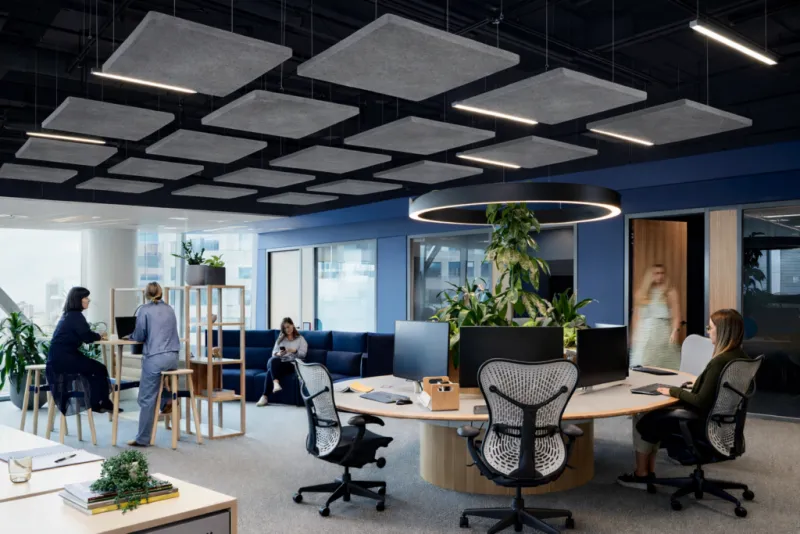
When Saving on Desks Costs You Your Best People: The True Price of Aggressive Hot-Desking

Photo: Valis55, CC BY-SA 3.0, via Wikimedia Commons
The logic seems airtight on the surface. Office utilization data shows that assigned desks sit empty 40 to 60 percent of the time. Real estate represents one of the largest line items on the enterprise balance sheet. Eliminating assigned seating and consolidating workstations should, in theory, unlock meaningful savings without meaningful sacrifice.
For a growing number of organizations, that theory is colliding with a harder reality: the employees most critical to long-term performance are quietly updating their resumes.
The Cost Calculation Enterprises Are Getting Wrong
When finance teams build the business case for activity-based working, the numbers on the savings side of the ledger are precise and immediate. Reduced square footage. Lower occupancy costs per head. Fewer workstations to maintain. These figures are tangible, and they land well in board presentations.
What rarely appears in those same presentations is the fully loaded cost of voluntary turnover. Depending on seniority and specialization, replacing a single employee can run between 50 and 200 percent of that person's annual salary when you account for recruiting fees, onboarding time, lost institutional knowledge, and the productivity drag on remaining team members. A mid-sized enterprise losing even a handful of high performers annually to workspace dissatisfaction is absorbing a cost that would dwarf the savings from a reduced desk-to-employee ratio.
A 2023 survey by CBRE found that 73 percent of employees who reported low satisfaction with their physical work environment also reported actively considering leaving their employer within the following 12 months. The workspace is not a peripheral variable in retention. For many employees, it is a central one.
What Hot-Desking Actually Does to Teams
The organizational damage from poorly implemented desk-sharing policies tends to manifest in three distinct ways, each of which compounds the others.
Erosion of psychological ownership. Research in environmental psychology consistently demonstrates that humans perform better in spaces they perceive as their own. The ability to personalize a workspace — even modestly — correlates with higher engagement and a stronger sense of organizational belonging. When that ability is removed, a subtle but measurable disengagement often follows. Employees begin to feel like visitors in their own office, which is precisely the opposite of what high-performance culture requires.
Disruption of informal team networks. Proximity is not incidental to collaboration. It is foundational to it. Studies on organizational network analysis repeatedly confirm that employees who sit near one another communicate more frequently, share information more openly, and solve problems faster. Hot-desking scatters these networks randomly, forcing teams to rebuild working relationships from scratch on a near-daily basis. The friction is invisible on any utilization dashboard but highly visible in project timelines and cross-functional coordination failures.
Disproportionate impact on specific worker profiles. Not all employees experience desk-sharing the same way. Introverted workers, those managing complex cognitive tasks requiring deep focus, employees with accessibility needs, and team leads who depend on consistent physical availability to their direct reports all face amplified costs from unassigned seating. An enterprise applying a uniform hot-desking policy across every function is, in effect, optimizing the workspace for its most mobile employees while penalizing the rest.
The Framework for Deciding Who Actually Benefits
The most effective workspace strategies do not treat desk-sharing as a blanket policy. They treat it as a tool — one that delivers genuine value in specific contexts and genuine harm in others.
Consider evaluating your workforce across two axes: mobility and interdependence.
Employees who are highly mobile (frequent travelers, field-based consultants, client-facing sales professionals) and who work with low day-to-day interdependence on a fixed team are natural candidates for unassigned seating. They are rarely in the office long enough to benefit from a dedicated space, and their collaboration patterns are not geography-dependent.
Employees who are present in the office with regularity and whose work requires sustained coordination with a stable team — engineering squads, legal departments, finance operations, creative production units — are poor candidates for aggressive hot-desking. The cost of disrupting their proximity and routine almost always exceeds the real estate savings.
A practical starting point is auditing badge access and meeting room data to identify which teams demonstrate consistent co-location patterns. Those patterns are not inefficiency. They are evidence of functional working relationships that your workspace policy should protect, not dismantle.
Rethinking the Desk Ratio
Many enterprise real estate strategies currently target desk-to-employee ratios of 0.6:1 or lower. For organizations with genuinely distributed, mobile workforces, this can be entirely appropriate. For organizations applying that same ratio to sedentary, team-dependent functions, it is a retention liability dressed up as a cost strategy.
The more productive question is not "how few desks can we provide?" but rather "what desk allocation model best supports the actual work patterns of each team, and what is the full financial consequence of getting that wrong?"
Enterprise workspace decisions made purely on occupancy data and square footage costs are, at best, incomplete. At worst, they are quietly subsidizing your competitors' recruiting efforts.
MasterSpace works with enterprise clients to develop workspace allocation frameworks grounded in both utilization intelligence and workforce behavior analysis — because the most expensive desk in your portfolio is the one that drove your best employee out the door.