When Facilities and IT Never Talk: The Physical Workspace Decisions That Are Opening Your Enterprise to Security Risk
The breach did not begin with a sophisticated phishing campaign or an advanced persistent threat. It began with a conference room renovation.
The scenario — drawn from a pattern that security consultants describe with increasing frequency — unfolds like this: a facilities team, operating under pressure to modernize a regional office, installs a new video conferencing system, upgrades the room's wireless access points, and integrates a smart booking panel into the building's management platform. The project is completed on time and under budget. IT is notified after the fact, if at all. Several months later, a security audit reveals that the devices were installed on the corporate network with default credentials, the booking panel's software has not been patched since installation, and the wireless access points are broadcasting on a frequency that is accessible from the building's parking structure.
This is not a facilities failure. It is a governance failure — and it is far more common than most enterprise security teams are comfortable acknowledging.
The Structural Divide That Creates the Risk
In most large US enterprises, the teams responsible for physical workspace — facilities management, corporate real estate, and workplace experience — operate under a fundamentally different organizational mandate than the teams responsible for digital security. Facilities teams are evaluated on cost efficiency, employee satisfaction scores, and project delivery timelines. IT security teams are evaluated on threat detection, compliance posture, and incident response metrics. These mandates rarely overlap, and the organizational structures that have evolved around them rarely require the two groups to collaborate on individual decisions.
The consequence is that an enormous category of decisions — which technologies get installed in physical spaces, how those technologies connect to enterprise networks, who has physical access to which areas and under what authentication conditions, and how data generated by workplace sensors and systems is stored and protected — falls into the gap between the two functions. Neither team owns it fully, and as a result, neither team reviews it consistently.
The Specific Vulnerabilities That Emerge
The security risks created by this divide are not uniform, but several categories appear with particular regularity in enterprise environments.
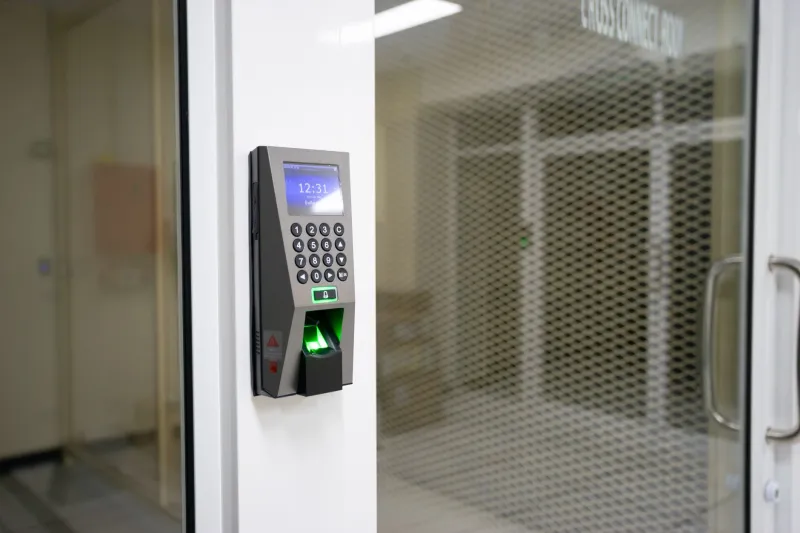
Access control misalignment. Physical access systems — badge readers, biometric scanners, keypad-controlled zones — are typically procured and managed by facilities teams. However, these systems increasingly operate as networked devices that interact with identity management infrastructure maintained by IT. When facilities teams upgrade or replace access hardware without coordinating with IT, the result is often a period during which the physical and digital access records are out of sync. Former employees whose digital credentials have been revoked may retain physical access. Contractor credentials may be extended without review. The audit trail that security teams rely on for incident reconstruction becomes unreliable.
Unsecured IoT endpoints. The modern enterprise workspace is dense with connected devices: environmental sensors, occupancy monitors, smart lighting controllers, AV systems, digital signage platforms, and building management infrastructure. Each of these represents a potential entry point into the enterprise network if not properly configured, segmented, and maintained. Facilities teams are generally not equipped to assess the security implications of these devices, and IT teams are frequently not informed of their installation until a problem surfaces.
Data handling in collaboration spaces. Shared meeting rooms, executive suites, and visitor-accessible areas present particular challenges for data governance. Whiteboards that photograph and upload content to cloud platforms, AI-enabled transcription services embedded in conferencing hardware, and ambient voice-activated devices all generate and transmit data in ways that may conflict with the organization's data handling policies or regulatory obligations. The question of which team is responsible for ensuring that these devices comply with applicable requirements — HIPAA, CCPA, FTC guidelines, or sector-specific standards — is frequently unanswered.
Visitor and contractor access in flexible environments. The growth of multi-tenant, co-working, and hoteling arrangements has introduced new complexity into enterprise access management. When employees work from shared facilities, the physical security perimeter becomes porous in ways that traditional corporate real estate does not. Sensitive conversations happen in spaces that are not under the organization's control. Devices connect to networks whose security posture the enterprise cannot audit.
What Integrated Workspace Security Governance Requires
Addressing these vulnerabilities does not require reorganizing the enterprise or merging the facilities and IT functions. It requires establishing deliberate governance mechanisms that ensure security considerations are embedded into workspace decision-making before commitments are made, not reviewed after the fact.
Several elements are consistently present in organizations that manage this well.
A joint review process for workspace technology procurement. Any technology device or system intended for installation in a physical workspace — regardless of whether the purchase is initiated by facilities, IT, or a business unit — should be subject to a security review before procurement is finalized. This review should assess network connectivity requirements, credential management practices, software update mechanisms, and data transmission behavior.
Defined ownership for workspace IoT device management. The question of who is responsible for patching, monitoring, and eventually decommissioning networked devices in physical workspaces must be answered explicitly. In many organizations, this responsibility falls to IT security, with facilities teams responsible for notifying IT of any new installations or removals.
Physical-digital access synchronization protocols. Identity lifecycle management processes — onboarding, offboarding, role changes — should automatically trigger reviews of both digital and physical access credentials. The two should not be managed on separate timelines.
Security representation in workplace design projects. For any facility renovation or new workspace buildout of meaningful scale, IT security should have a defined seat in the project team from the planning phase forward. This is not about slowing down facility projects — it is about ensuring that security requirements are incorporated into design specifications rather than retrofitted after construction.
The Compliance Dimension
For enterprises operating in regulated industries — financial services, healthcare, defense contracting, and others — the stakes extend beyond operational security risk. Regulators are increasingly attentive to the physical dimensions of information security. The SEC's cybersecurity disclosure rules, HIPAA's physical safeguard requirements, and various state-level privacy regulations all create potential liability exposure when physical workspace decisions are made without reference to the organization's compliance posture.
The enterprise that cannot demonstrate that its physical and digital security controls are integrated and consistently applied is not just operationally vulnerable. It is potentially exposed to regulatory scrutiny that its legal and compliance teams may not be prepared to manage.
Closing the Gap Before It Becomes a Crisis
The good news is that the governance mechanisms required to address this problem are not technically complex or prohibitively expensive. They require organizational will more than they require budget. The enterprises that are getting this right are doing so not because they have deployed sophisticated new tools, but because they have established clear expectations about who talks to whom before decisions are made.
In a threat environment that is growing more sophisticated by the quarter, the enterprise that treats its physical workspace as a security domain — not just a real estate and facilities question — is the one that will avoid the breach that begins with a conference room renovation.